
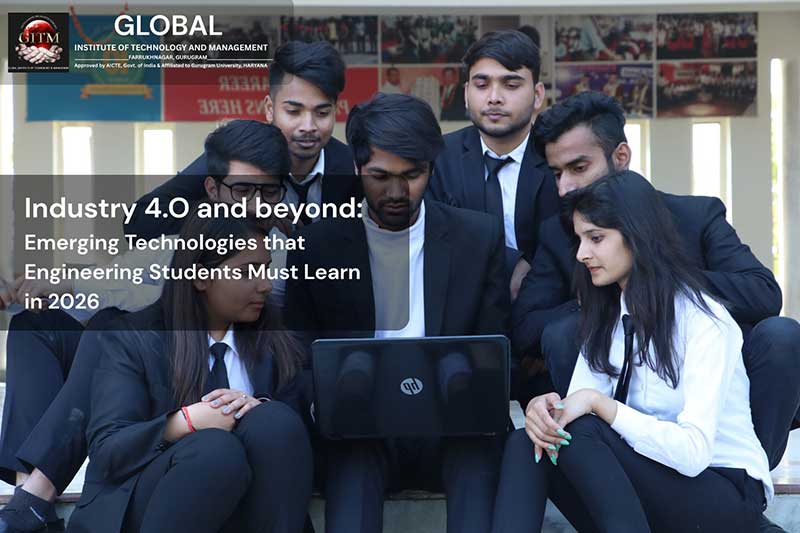
Industry 4.O and beyond: Emerging Technologies that Engineering Students Must Learn in 2026
As we step closer to a new year 2026, The engineering landscape is evolving faster than ever before. Traditional engineering knowledge solely is no longer enough. Corporate today demand future-ready engineers—professionals who can blend the engineering principles with today’s Emerging technologies, global exposure, and innovation-driven thinking.
At Global Institute of Technology and Management (GITM), we strongly believe that engineering education must go beyond classrooms study and textbooks Knowledge. Our academic ecosystem is designed to prepare students for Industry 4.0 and beyond, ensuring they graduate not just with their degrees, but with skills, confidence, and global competence.
Here are the top emerging technologies engineering students must learn in 2026, and how GITM is actively embracing them to their students.
1. Artificial Intelligence (AI) & Machine Learning (ML)
AI and ML are redefining almost about every sector—from manufacturing and Healthcare to finance and smart cities. Engineers of the future must understand how machines learn, predict, and automate decision-making in real time analysis.
At Global Institute of Technology and Management (GITM):
We integrate AI and ML fundamentals into our curriculum through:
- Practical lab sessions and mini-projects that run by our students.
- Industry-aligned workshops including Expert talk with Industry Domain Expert.
- Exposure to real-world datasets and problem-solving that nurture students their analytical Skills.
Our goal is to ensure students to build AI solutions, not just study theory.
2. Generative AI & Large Language Models (LLMs)
Generative AI is transforming software development, content creation, automation, and research. Engineers who understand tools like Catgut, Copilot, and AI agents will have a significant career advantage.
At GITM:
Students are introduced to:
- Prompt engineering and AI-assisted development Networking
- Ethical use of AI in engineering solutions to make our work smooth and flexible.
- Innovation-driven projects using generative AI tools
We prepare students to work with AI, not to be replaced by it.
3. Cyber security & Ethical Hacking
As digitalization systems is growing, so do cyber threats are rapidly increasing. Engineers must be potential enough of designing secure, resilient systems.
At GITM:
We emphasize:
- Cyber security fundamentals across engineering domains
- Awareness of data privacy, digital ethics, and cyber laws
- Hands-on exposure through simulations and case studies
4. Cloud Computing & DevOps
Modern engineering solutions rely on cloud platforms and continuous deployment. Cloud computing and DevOps are now core industry requirements.
At GITM:
Students gain exposure to:
- Cloud concepts and architectures that are used in online platforms
- DevOps tools and automation basics
- Industry-driven project development and simulation technology
This ensures that our graduates are industry-ready.
5. Internet of Things (IoT) & Smart Systems
IoT bridges hardware and software, enabling smart homes, smart factories, and smart cities through Automated Technology.
At GITM:
We promote that our students must be potential enough to learn these technologies:
- Interdisciplinary knowledge across electronics, computer science, and mechanical engineering
- Hands-on experience on IoT-based projects
- Industry-relevant applications and innovation challenges working modules.
Our students learn how to connect the physical and digital world.
6. Robotics & Autonomous Systems
Robotics is no longer limited to factories—it is shaping healthcare, defence, logistics, and agriculture. Robotics involves the design, development, and deployment of machines that is capable of performing tasks with less human intervention. Autonomous systems integrate artificial intelligence (AI), sensors, machine learning, and control systems, enabling robots to make their decisions, adapt to environments, and operate independently.
At GITM:
We nurture:
- Design thinking and automation skills in our curriculum planning.
- Exposure to sensors, control systems, and AI-driven robotics
- Innovation-focused student projects and competitions enhancing their skills.
7. Sustainable & Green Technologies
Sustainability is no longer an optional need. Engineers must design solutions that are environmentally responsible and socially impactful. Sustainability is a necessity. As the world faces climate change, resource depletion, and environmental degradation, engineers play an important role in designing solutions that are environmentally responsible, economically viable, and socially impactful. Sustainable and green technologies are at the core of this global transformation.
At GITM:
We emphasize:
- Green engineering practices: Engineering students work on projects such as energy-efficient lighting systems, low-power embedded devices, and waste-minimization models for industrial processes.
- Sustainable design principles: Rainwater harvesting systems, and recyclable material-based products as part of academic and capstone projects that they work under the Guidance of Teachers.
- Awareness of renewable energy and eco-friendly technologies
8. Data Analytics & Data Engineering
Data is the backbone of modern decision-making. Engineers who can analyse and interpret data will lead future organizations.
Data Analytics focuses on examining datasets to uncover patterns, trends, and insights that support strategic decisions. It involves statistical analysis, data visualization, and predictive modelling.
Data Engineering, on the other hand, deals with building and maintaining the infrastructure that enables data collection, storage, processing, and accessibility. Data engineers ensure that high-quality data is available for analysis at scale.
At GITM:
Students are trained in:
- Data literacy and analytical thinking
- Practical applications across engineering domains
- Industry-oriented problem-solving approaches
Beyond Technology: Building Future-Ready Engineers at GITM
At Global Institute of Technology and Management, we go beyond emerging technologies by focusing on:
- Industry–academia collaboration
- Skill-based and outcome-oriented education
- Innovation, entrepreneurship, and research culture
- Leadership, communication, and global exposure
Our mission is clear: to create engineers who are adaptable, innovative, and globally competitive.
The engineers of 2026 will not be defined by what they know, but by how fast they can learn, adapt, and innovate. Emerging technologies will continue to evolve—but the right educational foundation makes all the difference.
At Global Institute of Technology and Management (GITM), we proudly embrace this future by empowering our students with knowledge, skills, and vision to lead in a technology-driven world.
Shape your future. Engineer your success. Grow globally—with GITM.